
6 interesting curiosities on the planet Uranus

The seventh planet in order of distance from the Sun, will be in opposition to our star on October 28, 2019. This is a good opportunity to learn more about Uranus. Here are 6 curiosities on the planet.
Uranus, from the name of the Greek father of Cronus (Saturn) presents like every planet, characteristics that make it unique. During the month of October we had

the opportunity to observe it, in Aries, for the whole night. On October 28th it will reach opposition to the Sun, and we take this opportunity to get to know this fascinating planet more closely.
Uranus is the seventh most distant planet from the Sun
Uranus stands at a distance of about 2.9 billion km from the Sun (19.8 astronomical units).
It is the seventh Solar System planet in order of distance from our star. The sunlight takes 2 hours and 40 minutes to reach Uranus.
It is a frozen and… imposing planet
Like Jupiter, Saturn and Neptune, Uranus covers the “role” of the gas giant of our Solar System. However, it has the peculiarity of being “ice”, like Neptune, therefore known as “ice giant“: the presence of water, methane and ammonia make its also the coldest atmosphere of the Solar System, which reaches -224.2 ° C. The mass of Uranus is impressive and is about 4 times that of the Earth. Its radius is 25.362 km.
The planet Uranus and its rings
Uranus has 13 known rings. The outer ones are brighter than the interiors, which are dark and gray in color. Dust disks surround some of the larger rings.
Many satellites for Uranus
27 small known moons revolve around the planet. These have the peculiarity of having names that come from characters in the works of Shakespeare and Pope. Moreover, the more internal satellites are formed mainly by ice and rocks. The composition of the outer satellites remains unknown.
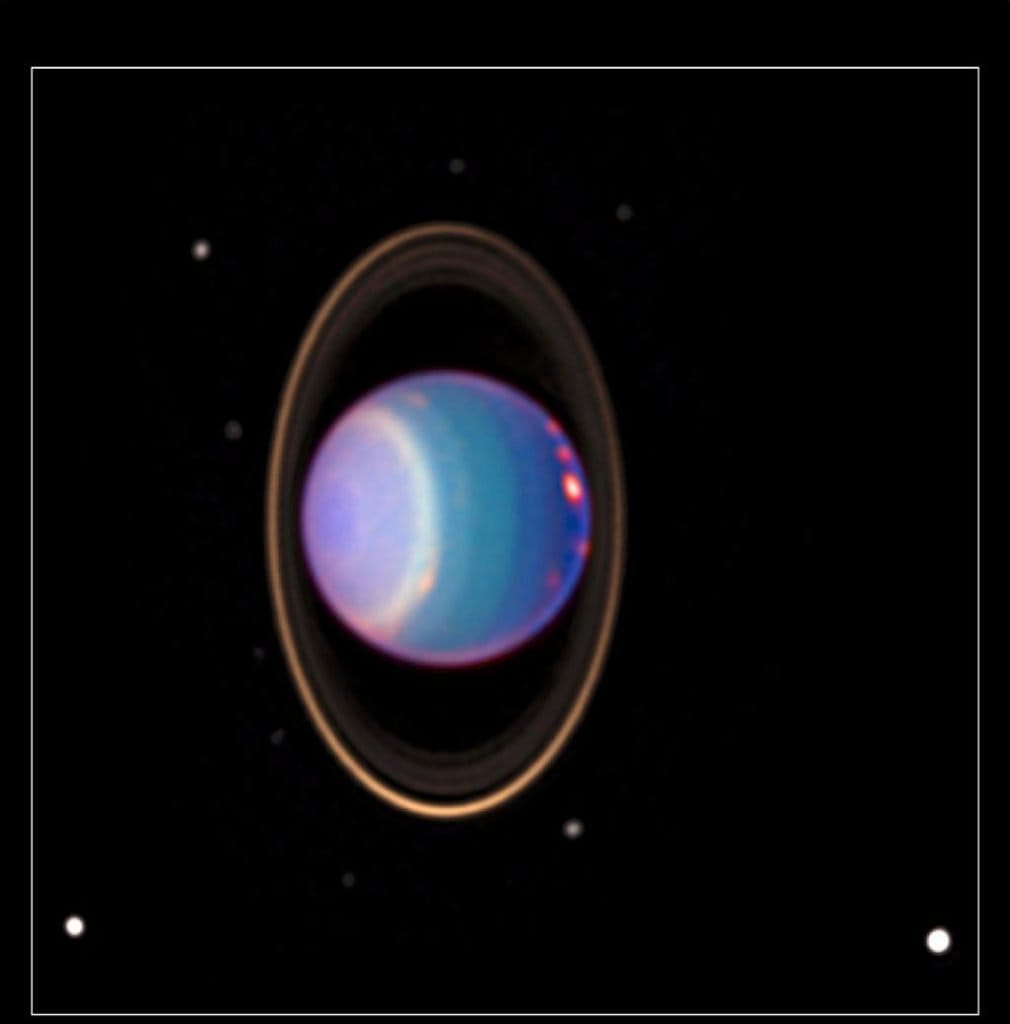
A very inclined axis
Uranus is the only planet to have an axis of rotation almost parallel to the plane of its orbit. In contrast, the other planets of the Solar System rotate on themselves almost perpendicular to the orbital planes. Its rotation is retrograde (like that of Venus).
Duration of the year and day
Its period of revolution around the Sun is equal to 84 Earth years. The duration of the day is very short and is 17 hours 14 minutes and 24 seconds.
What will happen on October 28th?
The planet Uranus will be in opposition to the Sun. It will be in the opposite direction (at 180°) with respect to our star. From the Earth we can see Uranus brighter, precisely in the constellation of Aries with an apparent magnitude of +5.7. It will also be clearly visible, using binoculars or telescopes from sunset to sunrise for the duration of the month.
Some of the information from the website: https://www.nasa.gov

