
Full Moon Names and Meanings
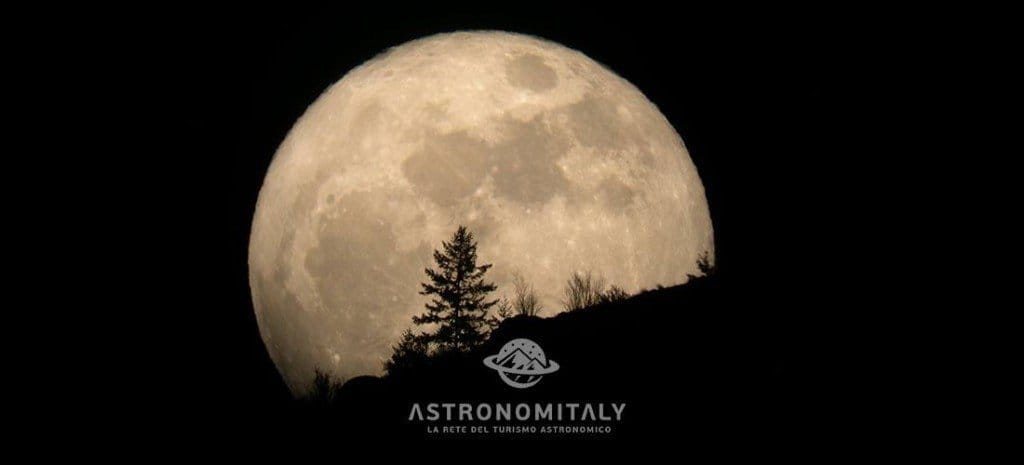
Today we simply call it the Full Moon, but every full moon actually has its own name, based on the month in which it occurs.
Leggi in italiano: I nomi della Luna Piena e i loro significati
Always beautiful to admire, with the naked eye or through a telescope, the Moon captures the gaze of stargazers and dreamers alike. About every 29.5 days it lies on the opposite side of the Sun from Earth, and we see its whole hemisphere lit by sunlight: the Full Moon.
Each monthly cycle of our natural satellite ends in a new full moon with a name of its own. The names of the Full Moon come from Native American traditions and describe the character of Nature in each month. Tribes kept track of the seasons by giving a different name to each Full Moon, which happens once a month, although every 2-3 years on average a month has two full moons instead of one: the so-called Blue Moon. The Moon never actually turns blue.
The best-known names are those of the Algonquin people, who lived in the New England area and west of Lake Superior, later adopted by European settlers and popularised in modern times by the Farmers’ Almanac.
An important note: these are names from North American tradition, not from Italian folk tradition, and there is no official naming. Names varied from tribe to tribe, and the same Moon often had more than one, as you will see below.
To find out the day and time of every full moon, see our lunar calendar of the year.
When is the Full Moon in 2026
| Month | Name | Date and time (Rome) |
|---|---|---|
| January | Wolf Moon | 3 January, 11:02 |
| February | Snow Moon | 1 February, 23:09 |
| March | Worm Moon | 3 March, 12:37 |
| April | Pink Moon | 2 April, 04:11 |
| May | Flower Moon | 1 May, 19:23 |
| May | Blue Moon | 31 May, 10:45 |
| June | Strawberry Moon | 30 June, 01:56 |
| July | Buck Moon | 29 July, 16:35 |
| August | Sturgeon Moon | 28 August, 06:18 |
| September | Harvest Moon | 26 September, 18:49 |
| October | Hunter’s Moon | 26 October, 05:11 |
| November | Beaver Moon | 24 November, 15:53 |
| December | Cold Moon | 24 December, 02:28 |
Times calculated with the JPL DE421 astronomical ephemeris, in Rome time.
January: Wolf Moon
In the deep cold of midwinter, packs of hungry wolves howled outside the villages.
February: Snow Moon
Heavy snow fell. Some northern and eastern tribes also called it the Hunger Moon, because the harsh weather made hunting very difficult.
March: Worm Moon
The temperature began to warm, the ground softened and earthworm trails appeared, announcing the return of the robins. Northern tribes also called it the Crow Moon, because the cawing of crows marked the end of winter.
April: Pink Moon
Wild ground phlox bloomed, a plant with pink flowers among the first to blossom in spring, the meadows filled with grass and fish spawned. The name refers to the flowers, not to the colour of the Moon.
May: Flower Moon
Flowers bloomed everywhere and the corn was ready to be planted.
June: Strawberry Moon
It was the month of the strawberry harvest and of ripening wild berries.
July: Buck Moon
The antlers of male deer began to regrow. In lower areas hay was cut, while in higher areas summer thunderstorms began, which is why it was also called the Hay Moon or Thunder Moon.
August: Sturgeon Moon
Rivers and lakes were full of sturgeon. Also called the Grain Moon or Red Moon.
September: Harvest Moon
Harvesters worked through the night, thanks to the moonlight, to gather the grain. It was the time of the last harvests of the land.
The Harvest Moon is, by definition, the Full Moon closest to the autumn equinox: it usually falls in September, but in some years it happens in October. In that case the Hunter’s Moon slips to November.
October: Hunter’s Moon
Hunting was easy and people gathered provisions for winter before the arrival of frost and snow.
November: Beaver Moon
It was the time to set traps for beavers, to secure meat and furs for the winter.
December: Cold Moon
The great winter arrived, with its short days and intense cold.
Blue Moon
The lunar cycle lasts about 29.5 days, so the exact dates of the Full Moon change every year. In the most common modern definition, a Blue Moon is the second Full Moon in the same calendar month: it happens on average every 2-3 years, and in 2026 it falls on 31 May. There is also an older seasonal definition: the third Full Moon of a season that has four. In both cases, colour has nothing to do with it.
Supermoon
We speak of a supermoon when the Full Moon falls close to perigee, the point where our satellite is closest to Earth. On those nights the disc looks up to 14% larger and up to 30% brighter than a Full Moon at its farthest. In the lunar calendar of the year you will find the distance from Earth of every full moon.
Where to observe the Moon and the stars with telescopes and the guidance of an expert?
Discover the AstroTours and see these wonders in person.
Source of the names: Farmers’ Almanac. Dates and times: JPL DE421 astronomical ephemeris processed by Astronomitaly.