
Lunar Calendar 2026: Full Moon and New Moon Dates for the Year
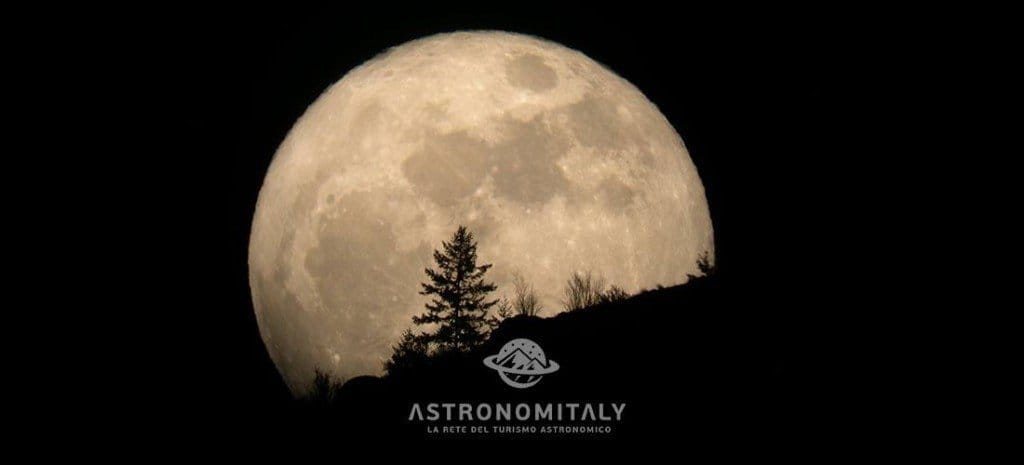
Lunar Calendar 2026: every Full Moon and New Moon, with date and Rome time
Leggi in italiano: Calendario lunare 2026
2026 brings 13 full moons and 12 new moons. The reason is a small quirk of the calendar: a full moon falls on 1 May and another on 31 May, and the second one is the so-called Blue Moon. It has nothing to do with colour: the Moon stays white, silver, sometimes orange near the horizon. The rest of the year runs regularly, with supermoons on 24 November and 24 December (the closest of the year, at about 356,700 km) and a summer marked by eclipses, with the New Moon of 12 August coinciding with a total solar eclipse.
Every Full Moon also has a name tied to the seasons and nature: in our article on the names of the Full Moon you will find all 12 meanings.
How to read the calendar
All times are in Rome time (CET in winter, CEST from the end of March to the end of October) and calculated with the JPL DE421 astronomical ephemeris. The Full Moon is the exact instant when the Moon lies opposite the Sun. To the eye the disc looks full the evening before and the evening after too, so there is no need to chase the exact minute. The New Moon is the instant when the Moon sits between Earth and Sun: the sky is free of moonlight and it is the best moment to observe the Milky Way and faint objects.
The distance from Earth changes by about 50,000 km from one month to the next, because the lunar orbit is elliptical. A supermoon is a Full Moon that falls close to perigee, the point of closest approach: it looks up to 14% larger and up to 30% brighter than a Full Moon at its farthest. There is no official definition, so sources do not always agree: we recognise a supermoon below roughly 361,500 km. The full moon of 3 January (362,300 km) is a borderline case: some sources, such as Fred Espenak’s tables, count it as a supermoon, others do not, so we mark it “borderline”. We call Blue Moon the second Full Moon in the same calendar month.
The eclipses of 2026
There are four eclipses this year.
17 February – annular solar eclipse: not visible from Italy.
3 March – total lunar eclipse: greatest eclipse at 11:34 UT, which is 12:34 Rome time, with the Moon below the horizon. Not visible from Italy.
12 August – total solar eclipse: totality crosses Greenland, Iceland and northern Spain. In Italy the eclipse is partial. Greatest eclipse is at 17:46 UT, which is 19:46 Rome time, so in the evening.
28 August – partial lunar eclipse: greatest eclipse at 04:13 UT, which is 06:13 Rome time, when dawn is about to break in Italy.
The 2026 lunar calendar, month by month
JANUARY – Wolf Moon (borderline supermoon)
Full Moon: 3 January 2026 at 11:02, distance from Earth about 362,300 km.
New Moon: 18 January 2026 at 20:51, distance from Earth about 395,400 km.
FEBRUARY – Snow Moon
Full Moon: 1 February 2026 at 23:09, distance from Earth about 371,400 km.
New Moon: 17 February 2026 at 13:01, distance from Earth about 384,500 km (annular solar eclipse).
MARCH – Worm Moon (total lunar eclipse)
Full Moon: 3 March 2026 at 12:37, distance from Earth about 382,600 km.
New Moon: 19 March 2026 at 02:23, distance from Earth about 373,300 km.
APRIL – Pink Moon
Full Moon: 2 April 2026 at 04:11, distance from Earth about 393,600 km.
New Moon: 17 April 2026 at 13:51, distance from Earth about 364,200 km.
MAY – Flower Moon and Blue Moon
Full Moon (Flower Moon): 1 May 2026 at 19:23, distance from Earth about 402,000 km.
New Moon: 16 May 2026 at 22:01, distance from Earth about 358,600 km.
Full Moon (Blue Moon): 31 May 2026 at 10:45, distance from Earth about 406,100 km.
JUNE – Strawberry Moon
New Moon: 15 June 2026 at 04:54, distance from Earth about 357,200 km.
Full Moon: 30 June 2026 at 01:56, distance from Earth about 405,300 km.
JULY – Buck Moon
New Moon: 14 July 2026 at 11:43, distance from Earth about 360,200 km.
Full Moon: 29 July 2026 at 16:35, distance from Earth about 399,600 km.
AUGUST – Sturgeon Moon (total solar eclipse and partial lunar eclipse)
New Moon: 12 August 2026 at 19:36, distance from Earth about 367,000 km (total solar eclipse).
Full Moon: 28 August 2026 at 06:18, distance from Earth about 390,400 km (partial lunar eclipse).
SEPTEMBER – Harvest Moon
New Moon: 11 September 2026 at 05:26, distance from Earth about 376,600 km.
Full Moon: 26 September 2026 at 18:49, distance from Earth about 379,400 km.
OCTOBER – Hunter’s Moon
New Moon: 10 October 2026 at 17:50, distance from Earth about 387,600 km.
Full Moon: 26 October 2026 at 05:11, distance from Earth about 368,900 km.
NOVEMBER – Beaver Moon (supermoon)
New Moon: 9 November 2026 at 08:02, distance from Earth about 397,800 km.
Full Moon: 24 November 2026 at 15:53, distance from Earth about 360,800 km.
DECEMBER – Cold Moon (supermoon)
New Moon: 9 December 2026 at 01:51, distance from Earth about 404,700 km.
Full Moon: 24 December 2026 at 02:28, distance from Earth about 356,700 km.
Where to observe the Moon with a telescope and an expert guide
A Full Moon through a telescope is almost dazzling, while it is the waxing and waning phases, with light skimming the terminator, that reveal the sharpest crater detail. Astronomitaly’s AstroTours take place in the places with the darkest skies in Italy, with professional telescopes and expert guides.
Eclipse source: NASA, Eclipses During 2026.