
Artemis II Live: Humanity’s Return to the Moon — Day-by-Day Mission Coverage
📡 Live update — April 5, 2026, Mission Day 5
It was 12:35 AM local time on April 2, 2026, in Italy. At Cape Canaveral, 6:35 PM on April 1st. The SLS rocket tore open the Florida sky in a column of white fire, lighting up the Atlantic coast for miles. Four human beings — Reid Wiseman, Victor Glover, Christina Koch, Jeremy Hansen — left Earth. Not just to orbit it, as astronauts do aboard the International Space Station. They went beyond. To the Moon. For the first time since December 1972, when Gene Cernan climbed back into the Apollo 17 lunar module and said goodbye to the lunar surface, humanity is once again heading toward our nearest neighbor.
Artemis II is a test flight, not a Moon landing. But its historical weight is enormous: it is the first crewed flight of NASA’s Artemis program — the essential prologue to the return of astronauts to the lunar surface planned for Artemis IV in 2028. And as you read this, the Orion capsule — named “Integrity” by the crew — is already more than halfway between Earth and the Moon, and tomorrow it will fly around the far side of our satellite. History happening in real time.
🚀 Meet the Artemis II Crew: Four People Making History
NASA assembled a crew that is, in itself, a statement. Commander Reid Wiseman, a veteran of ISS missions, is the oldest of the four. Pilot Victor Glover becomes the first African American to travel toward the Moon. Mission Specialist Christina Koch is the first woman to reach lunar orbit — holder of the record for the longest single spaceflight by a woman on the ISS. Completing the quartet is Jeremy Hansen, astronaut of the Canadian Space Agency (CSA), the first non-American to reach deep space.
With them aboard is Rise: the mission’s zero-gravity indicator, a small mascot designed by 8-year-old Lucas Ye of Mountain View, California, who won the NASA design challenge with an idea inspired by the iconic Earthrise photograph from Apollo 8 — Earth rising above the lunar horizon. Rise depicts the Moon wearing Earth as a baseball cap. Poetic and scientifically precise at the same time.
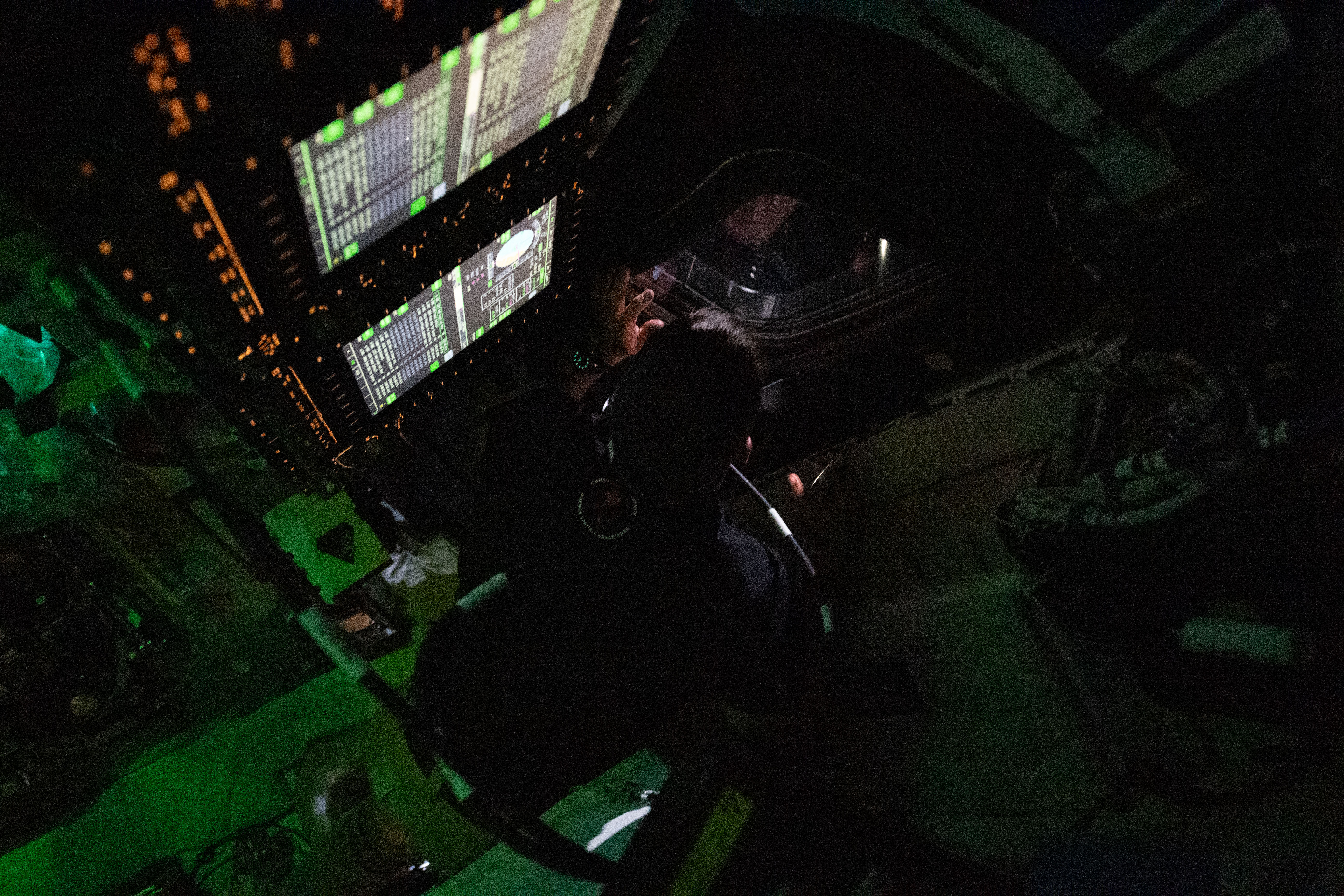
🛸 The SLS Rocket and Orion Capsule: Architecture for Deep Space
The Space Launch System (SLS) is the most powerful rocket NASA has ever built for crewed missions. It can carry the Orion capsule, astronauts, and cargo directly to the Moon in a single launch — something no other current vehicle can do. On April 1, 2026, at 6:35 PM EDT, the rocket lifted off from Launch Complex 39B at Kennedy Space Center in Florida — the same historic pad used for many Apollo missions.
The Orion capsule, heart of the Artemis architecture, is designed to sustain up to four astronauts in deep space for missions lasting up to 21 days. Its service module — critical for propulsion, power, and life support — is provided by the European Space Agency (ESA) through European industry. Shortly after launch, Orion’s four solar array wings deployed cleanly, giving the spacecraft a total wingspan of roughly 63 feet — the first power from the Sun on the journey to the Moon.
🌍 The First Images of Earth: A View Unlike Any Before
Hours after launch, the camera mounted on Orion’s solar arrays transmitted something extraordinary: Earth in a crescent shape, suspended in the absolute black of space. It is the first image of our home returned by eyes — even mechanical ones — that were truly moving away toward the Moon.
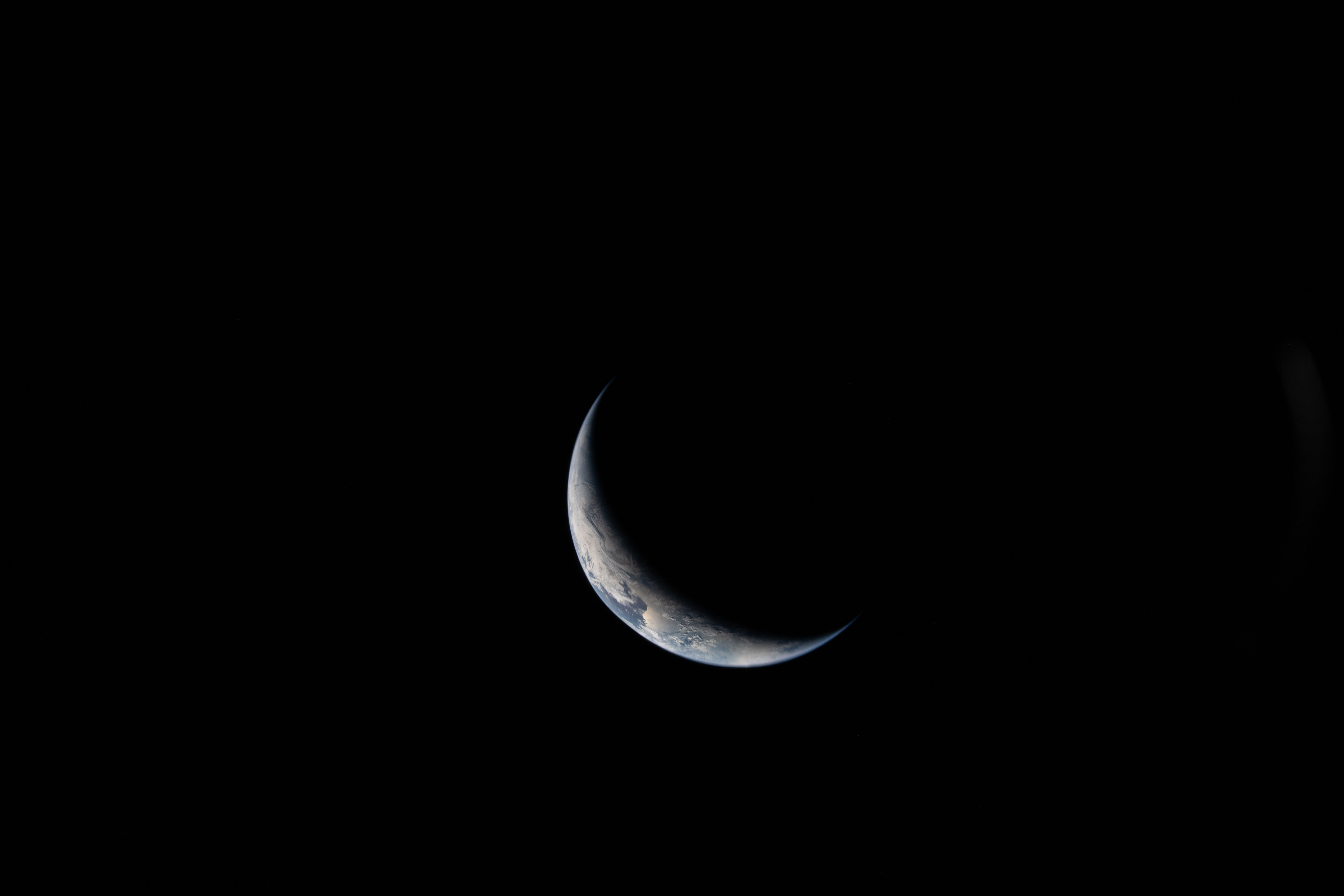
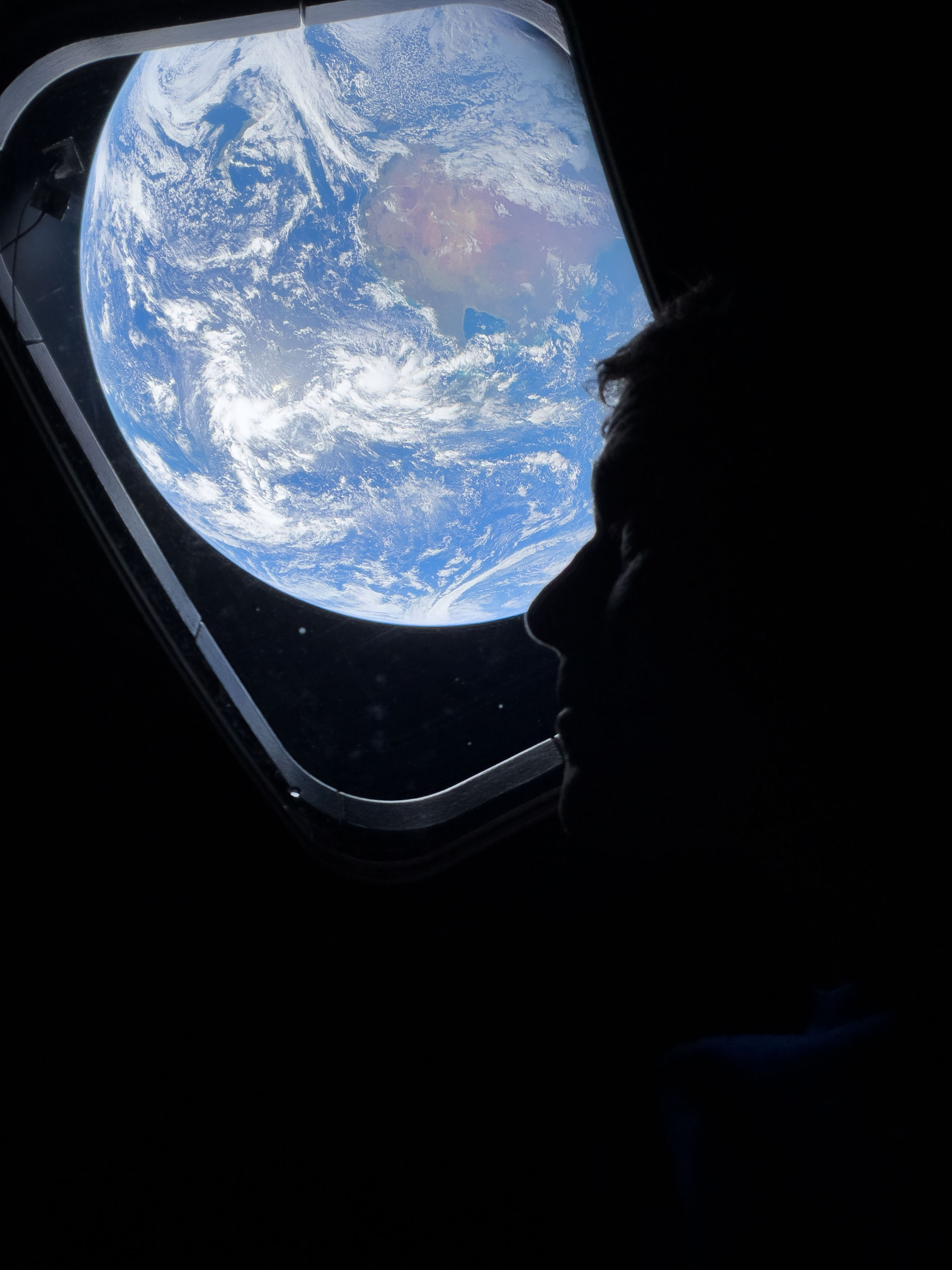
Canadian astronaut Jeremy Hansen, peering through Orion’s window, captured the moment in words: “We are admiring a gorgeous view of the dark side of the Earth, illuminated by the Moon. It is phenomenal. None of us can eat lunch because we are all glued to the windows.” Christina Koch added that she could make out entire continental coastlines, and even the South Pole — her former research home during her record-breaking ISS stay.
On April 3rd, NASA also released one of the photographs already destined to become iconic: Earth photographed through Orion’s window just after the translunar injection burn, with two distinct polar auroras visible in the upper-right and lower-left corners — and zodiacal light in the lower right. No crewed capsule had ever captured such an image before.
🔥 The Translunar Injection Burn: Goodbye, Earth Orbit
The most anticipated maneuver of the mission’s first phase occurred on April 2nd at 7:49 PM EDT. Orion’s service module main engine fired for 5 minutes and 50 seconds, accelerating the capsule by approximately 1,274 feet per second (388 m/s). That precise moment was epochal: for the first time since December 7, 1972 — the departure of Apollo 17 — human beings had left Earth orbit.
“Today, for the first time since Apollo 17 in 1972, humans have departed Earth orbit,” announced Dr. Lori Glaze, acting associate administrator for NASA’s Exploration Systems Development Mission Directorate. “Reid, Victor, Christina, and Jeremy now are on a precise trajectory toward the Moon. Orion is operating with crew for the first time in space, and we are gathering critical data.”
The burn placed Orion on a free-return trajectory: a path in which the Moon’s gravity acts as a natural slingshot, curves the capsule’s route around the Moon, and sends it back toward Earth without requiring additional major propulsive maneuvers — an intrinsic safety feature built into the mission design.
🌕 First Image of the Moon from Artemis II: Human Eyes on the Orientale Basin
On April 3rd, as the mission entered its third day, the Moon began to loom larger through Orion’s windows. One photograph that quickly went viral shows our satellite in the distance through the capsule’s window, against the sidereal darkness, as Earth recedes in the opposite direction.
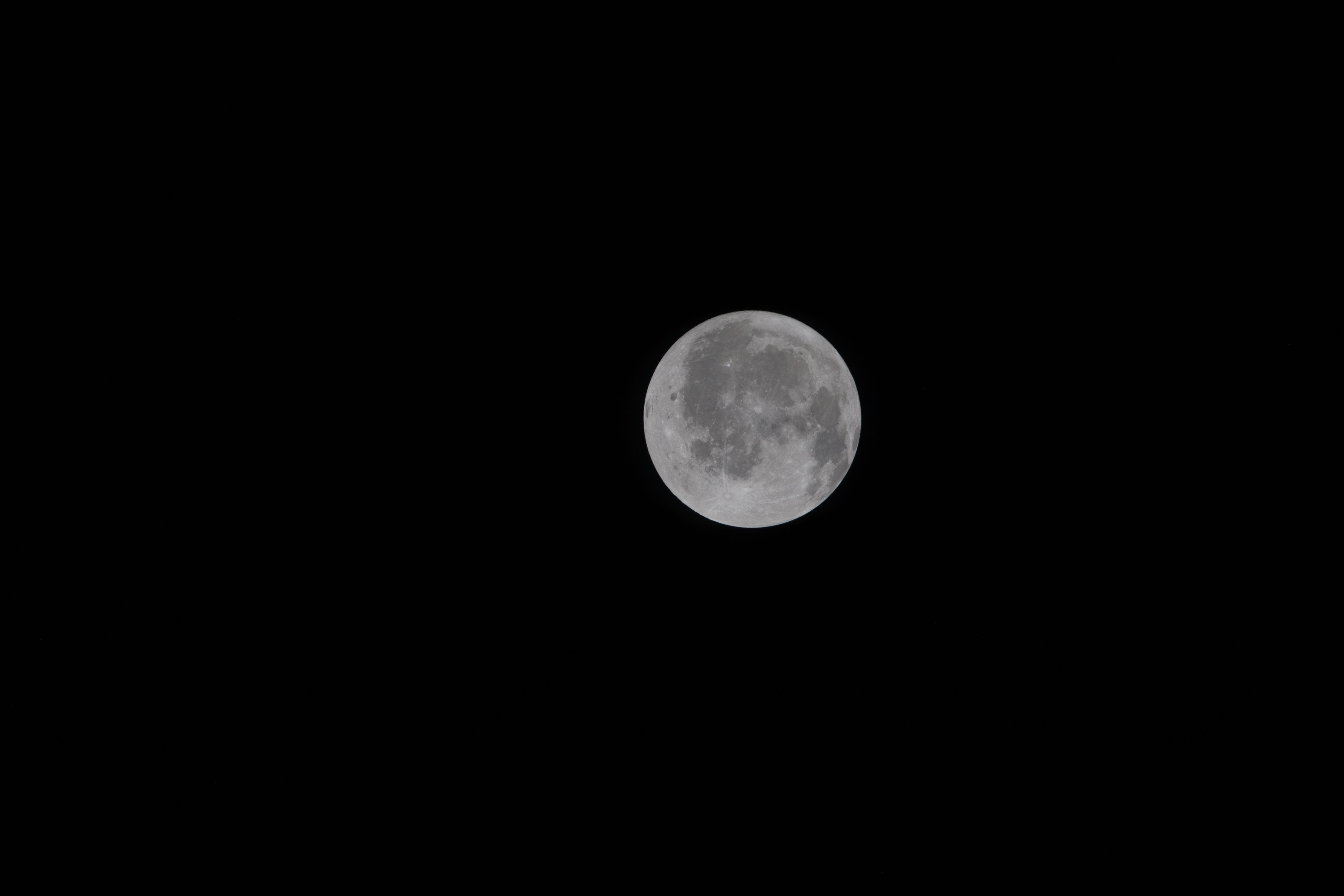
CNN reported that among the Day 3-4 images, one shows a portion of the Orientale Basin — a 600-mile-wide (965 km) impact crater located in the transition zone between the near and far sides of the Moon. It is the first time human eyes have seen it from this perspective: until now, only robotic imagers had photographed it. A record already broken, and the lunar flyby hasn’t even happened yet.
🎮 Day 4: Victor Glover Takes Manual Control in Deep Space
On April 4th, while the crew was approximately 169,000 miles (272,000 km) from Earth and 110,700 miles (178,000 km) from the Moon, Victor Glover took manual control of the Orion capsule for approximately 70 minutes. The planned test — overseen by Mission Control in Houston — is designed to gather data on the vehicle’s handling qualities in deep space: how it responds to commands, how it performs with four people aboard in weightlessness, how it executes precise movements in an environment with no friction and no fixed reference point.
The day also included a 24-hour acoustics test to characterize the sound environment inside the capsule — essential data for future longer missions, where chronic noise can become a significant stressor for crew members.
🌑 Today, Day 5: Orion Enters the Lunar Sphere of Influence
Today, April 5th, is the day the Moon “wins” over Earth. The sphere of gravitational influence is the volume of space within which one celestial body’s gravity exceeds another’s: from this moment, Orion is in the Moon’s gravitational domain. It is a mathematical boundary, not a physical one — yet it carries enormous symbolic weight. This is the moment the capsule stops “falling” toward Earth and begins “falling” toward the Moon.
The crew is finalizing preparations for tomorrow’s flyby. The science team in Houston has built a Lunar Targeting Plan — a detailed observation guide specifying what to photograph and study during the six-hour window when Orion will be close enough to the lunar surface for meaningful scientific observations: craters, ancient lava flows, fault systems, ridges — the geology of the Moon narrated for the first time by human eyes in close orbit.
🌒 Tomorrow, April 6: The Lunar Flyby — The Most Awaited Moment
The lunar observation window opens tomorrow, Monday April 6, at 2:45 PM EDT and lasts until 9:40 PM EDT. The highlight will be closest approach to the Moon, expected at approximately 7:02 PM EDT: Orion will pass just 4,066 miles (6,542 km) from the lunar surface. From this distance, the crew will see the entire lunar disk in a single frame — both poles included — a panorama no human has ever had.
For approximately 40 minutes, beginning around 5:47 PM EDT, Orion will pass behind the Moon: communications with Mission Control will be completely cut off. The Moon blocks radio signals — exactly as it did during the Apollo missions. A moment of silence that, for colleagues in Houston, is always charged with tension.
When Orion re-emerges, the crew will already be on the return trajectory toward Earth. But before that, one final spectacle: a total solar eclipse visible from inside the capsule, as the Sun disappears behind the Moon’s profile. An opportunity to observe objects normally invisible: meteoroid impact flashes on the lunar surface, dust lofting at the terminator edge, and perhaps planets in the airless sky.
🔬 Science on Board: The AVATAR Experiment and the Road to Mars
Artemis II is not merely a demonstration flight. Aboard Orion are scientific experiments designed to understand how deep space — with its elevated radiation levels and prolonged microgravity — affects the human body. The most innovative is AVATAR (A Virtual Astronaut Tissue Analog Response): it uses samples derived from the crew’s bone marrow, placed in microsystems called organ-on-a-chip devices. These replicate the behavior of real biological tissues in response to the space environment — information fundamental to planning missions to Mars, where the journey will last many months.
📱 How to Follow the Mission Live: Tools and Resources
- AROW — Artemis Real-time Orbit Website (nasa.gov/trackartemis): NASA’s official tracker showing Orion’s real-time position relative to Earth and the Moon, with distance, speed, and elapsed mission time. The mobile version adds an augmented reality feature: point your smartphone at the sky and see exactly where Orion is at that moment.
- NASA+ and NASA YouTube (youtube.com/@NASA): NASA streams live 24 hours a day from its official YouTube channel, with Orion’s external camera always active. When the capsule is in darkness the screen goes black; when communications are interrupted it turns blue — but the signal always returns.
- NASA Artemis Blog (nasa.gov/blogs/artemis): official milestone-by-milestone text updates from Mission Control Houston.
- @NASAArtemis on social media: real-time updates on X (Twitter), Facebook, and Instagram with official images published by the crew and NASA throughout the mission.
- Trajectory ephemeris data: after launch, NASA made Orion’s complete trajectory data available, updated in real time. These can be imported into software like Stellarium or Celestia to track the capsule with an amateur telescope.
🔭 Best Apps to Experience Artemis II
- NASA App (iOS and Android, free): integrates AROW directly, with push notifications for every mission milestone, real-time image feed, and access to NASA+. The primary gateway to all official mission material.
- NASA+ Streaming (web, iOS, Android, smart TV): free streaming platform with continuous live coverage, documentaries, technical briefings, and real-time expert commentary. Perfect for tomorrow’s lunar flyby.
- Stellarium (iOS, Android, web — free): the world’s most-used planetarium app. With TLE data available, you can calculate future passes of the capsule from your location.
- SpaceFlightNow (web): detailed technical editorial coverage, ideal for those who want engineering specifics beyond the main narrative.
🌏 What Happens Next: Splashdown and the Road to Artemis IV
After tomorrow’s lunar flyby, Orion will begin its return journey to Earth. Splashdown is expected on April 10, 2026, at approximately 8:06 PM EDT, in the Pacific Ocean off the coast of San Diego, California. U.S. Navy recovery teams will be standing by.
But the real journey is just beginning. Artemis II is the penultimate step before a Moon landing: Artemis III will carry astronauts into lunar orbit with SpaceX’s Starship HLS as the descent vehicle, while Artemis IV, planned for 2028, will be the first Artemis Moon landing — with a woman and an astronaut of color touching the lunar surface for the first time in history. The Moon’s south pole, rich in water ice, is waiting.
Everything happening right now — every burn, every trajectory correction, every photograph taken through Orion’s window — is data. Data that will be used to land human beings on the Moon in two years. And to slowly prepare the next step: Mars.